





Do you know where your lithium is?

Battery innovation is facing critical challenges: Lengthy development cycles, performance plateaus, and failure analysis bottlenecks.
What if the solution isn't just better battery chemistry, but better analytical tools?
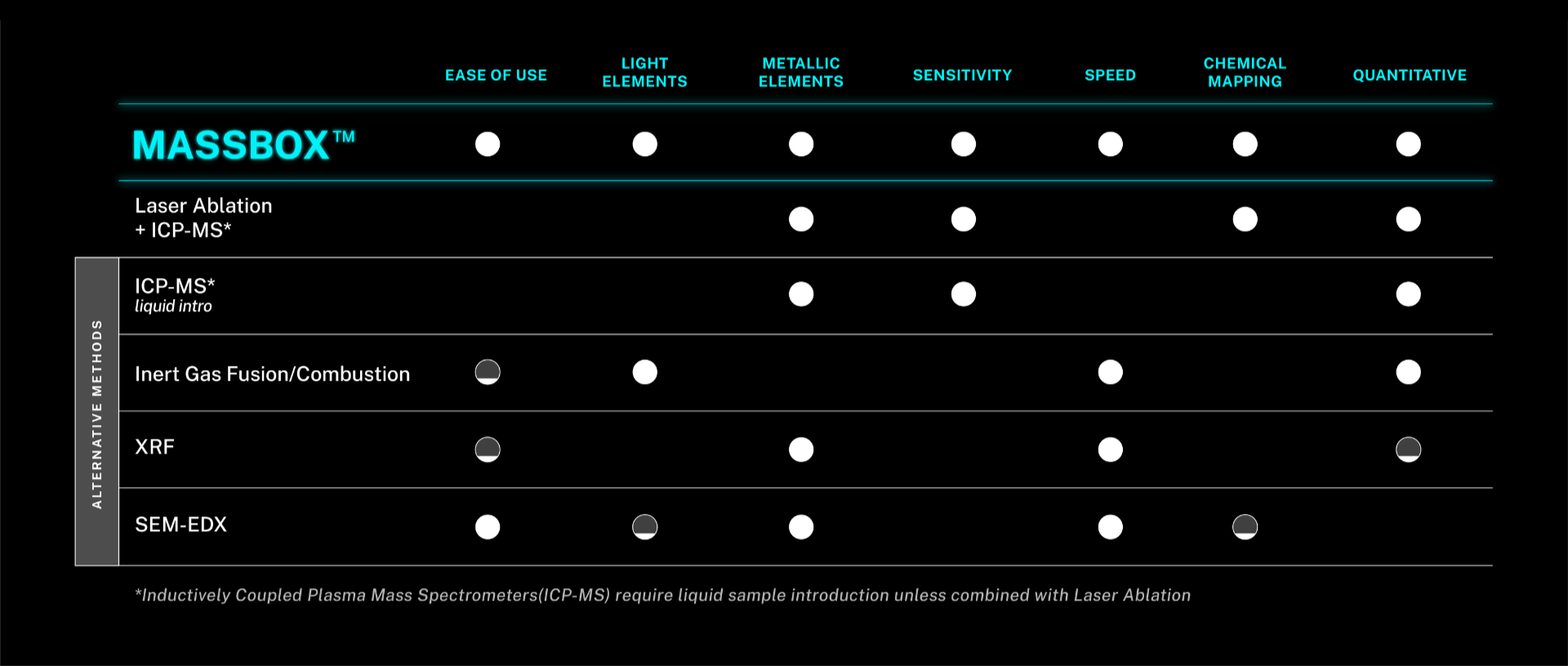
With Massbox™ LALI-TOF-MS technology, researchers are accelerating development by gaining unprecedented insight into lithium distribution, achieving comprehensive material characterization, and performing rapid failure analysis—all with a single desktop instrument.
Massbox delivers:
→ Detection from lithium to uranium
→ Large-scale elemental maps in minutes
→ Accurate diagnostics for battery failure analysis
3D Reconstruction of Electrodes
This 3D image was created from a 40-micron thick silicon anode. MassboxTM analyzed an area of 1 mm by 1 mm with 50-micron lateral resolution. This analysis was repeated until it ablated through the anode and into the copper current collector. Because each voxel contains a full mass spectrum of data, the results reveal a 3D distribution of lithium and other important elements.
This anode sample is at the top of charge. The lithium distribution, shown in green, appears relatively evenly distributed from the anode's surface to the copper (shown in orange). The fluorine distribution (shown in magenta) helps identify and characterize solid electrolyte interface (SEI) formation. Trace amounts of cobalt (shown in blue) reveal some contamination in the anode.
Overcome Your Battery Development Limitations
Discover How Massbox Is Revolutionizing Research & Development
Case Study: Lithium Mapping and Depth Profiling
Measuring the distribution of lithium within battery electrodes is important for understanding lithium ion behavior during charge and discharge cycles, characterizing the solid electrolyte interface (SEI) layers, and identifying areas of accumulation that may lead to plating or other failure mechanisms.
This study showcases how Massbox quantitatively measures lithium and lithium species spatially and in depth.
Case Study: Identifying Contamination in Electrodes
Advanced battery developers and cell manufacturers typically rely on a laboratory's worth of spectroscopy and microscopy tools to characterize common defects like particle contamination and inhomogeneities in electrode composition.
This study highlights Massbox's proficiency in scanning millimeter-scale areas of electrodes, pinpointing contaminant particles down to the micron scale, and effectively diagnosing their origins.