






There are two fundamental questions that drive geochemical analysis across various applications and research areas:
What is it? Where is it hosted?
Whether you're dealing with unexpected features, melt or fluid inclusions, or an unknown mineralogy; identifying what they are and tracing their origin is critical for research and industry.
Discover how precise elemental mapping and trace element compositional analysis is solving this challenge in the following application examples.
Trace Element Geochemistry for Mining and Exploration
Mining and exploration operations require multi-element geochemical data to characterize mineral systems.
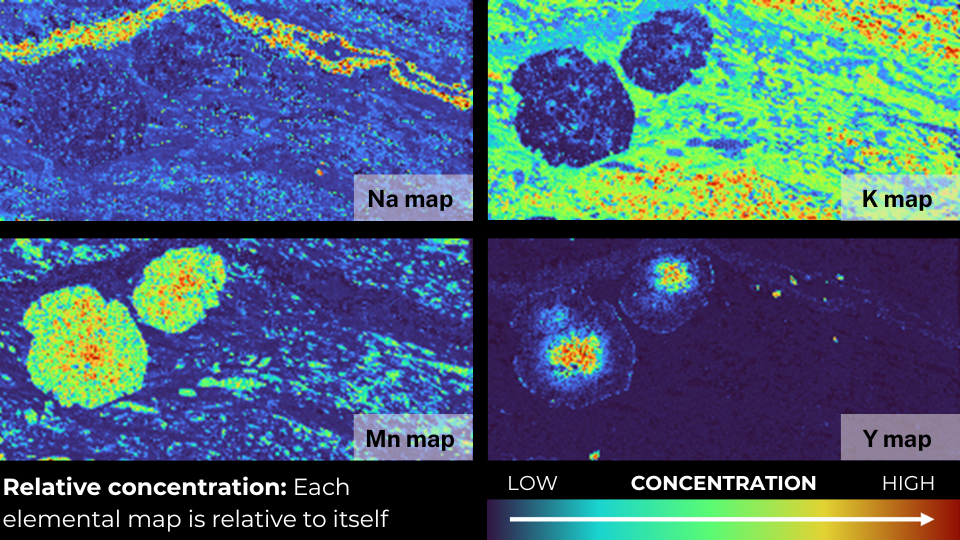
The Analysis: Massbox® acquired millimeter-scale elemental maps over a mineralogic thin section sample in ~25 minutes.
The Results: Through high-sensitivity, multi-element analysis, Massbox revealed:
- The distribution of key elements (e.g., Na, K, and Mn) used to characterize different mineralogy
- Trace elements (e.g., Y) that are below the detection limits of x-ray techniques
The Value: Trace element geochemistry is becoming increasingly important for discovering subtle deposits. Massbox combines trace element analysis and rapid elemental mapping into a field-deployable package.
Determining the Host of Critical Minerals
Mineralogy informs how to extract and process critical minerals. Although automated mineralogy tools are helpful, trace elements can provide important information required to fully characterize the mineralogy and determine its formation history.
The Analysis: Massbox performed comprehensive elemental mapping across a rock thin section and identified a zone rich in Co, the critical element of interest. A higher-resolution analysis determined the elements associated with the Co-rich zone.
The Results: Through precise elemental composition analysis, Massbox revealed:
- High Co corresponding with relatively low Fe and some areas of high Ti—major components of the primary mineralogies identified in the sample.
-
High Co corresponding with relatively high amounts of Zn—a trace element in the ppm range, which would have been below the detection limits of many other techniques.
The Value: Understanding the distribution of both major elements and trace elements allows a comprehensive understanding of target critical elements and their mineral hosts.
Beryllium Zoning in Granite for Gem-Quality Aquamarine
For certain gemstones, exploration and grading depend on measuring light elements that are notoriously hard to detect with conventional tools.
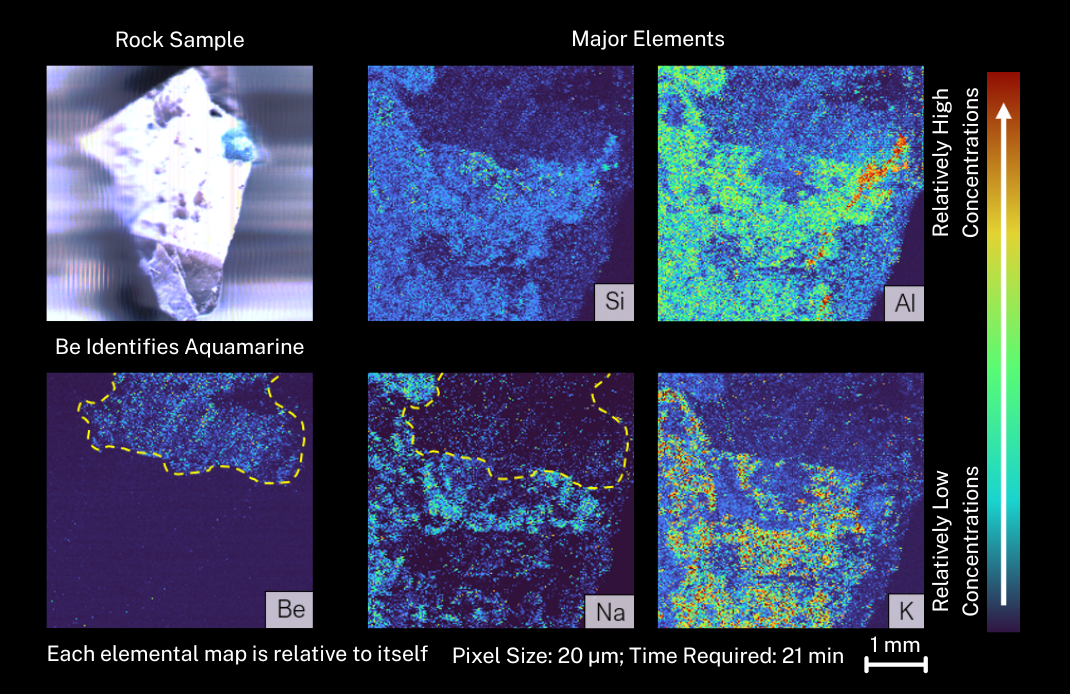
The Analysis: Beryllium (Be) is the element that defines aquamarine (beryl) and separates it from surrounding granite. Massbox directly measured Be in a rock sample collected from an area known for gem-quality aquamarine. Massbox simultaneously mapped Be alongside major elements (Si, Al, Na, K) at 20 μm resolution in ~21 minutes.
The Results: Through direct, high-sensitivity elemental mapping, Massbox revealed:
- Clear Be zoning that identifies aquamarine within the surrounding granite
- Multi-element mapping with precision and speed unmatched by other techniques
The Value: Traditionally, confirming gem-quality zoning using light elements like Be required sending samples out for lab analysis. Massbox delivers that capability outside the lab, letting exploration teams assess aquamarine potential on-site instead of waiting on external results.

Application Notes: Revolutionize Your Materials Analysis
Application Note:
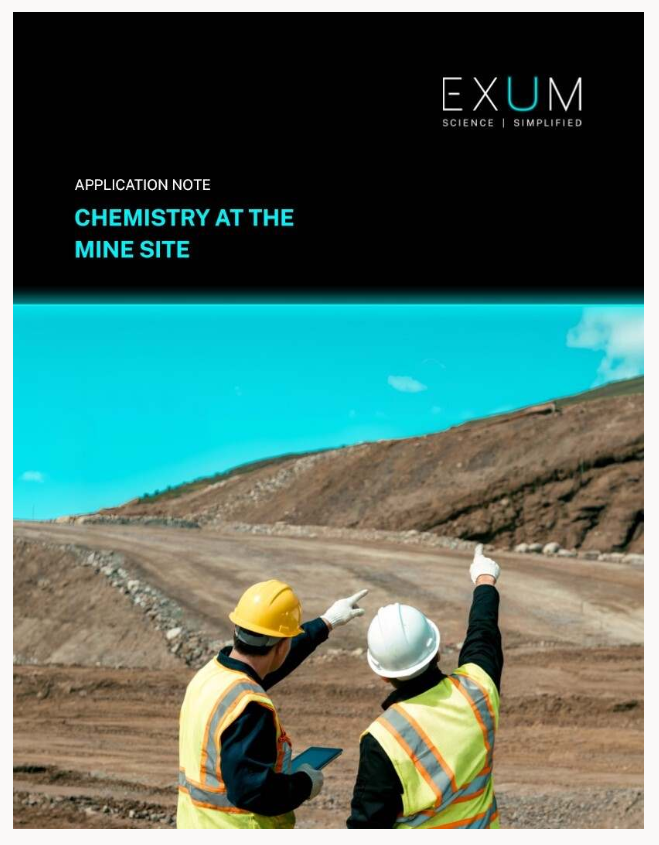
Chemistry at the Mine Site
Covering the analysis of a thin section core plug, this application note demonstrates how field-deployable technology enables rapid elemental mapping and trace-level quantification without requiring acid digestion, gas supplies, or trained chemists.
The results showcase elemental characterization of composite grains, trace lithium detection in distinct grains, and rare earth element quantification.
This application note demonstrates how bringing Massbox to field offices shortens exploration feedback loops from weeks to hours, enabling near-real-time decisions that optimize recovery and deliver operational agility.
Download Now:
Application Note:
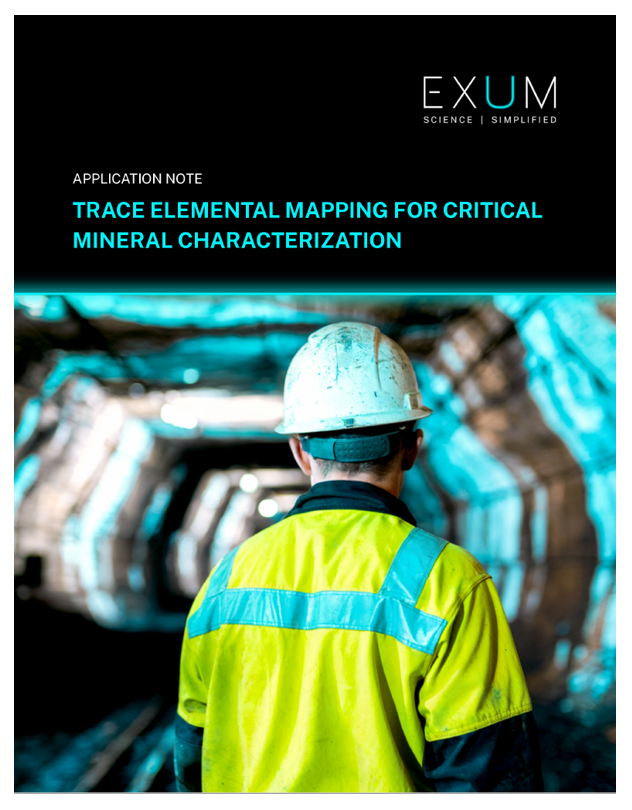
Trace Elemental Mapping for Mineral Characterization
Bulk geochemistry provides the full elemental suite but no spatial detail, while conventional microanalytical techniques offer resolution but cover only part of the periodic table.
Using LALI-TOF-MS, this application note demonstrates how the full periodic table can be mapped simultaneously with ppm-level sensitivity and micron-scale spatial resolution, with a full mass spectrum captured at every pixel.
Download Now:
Application Note:
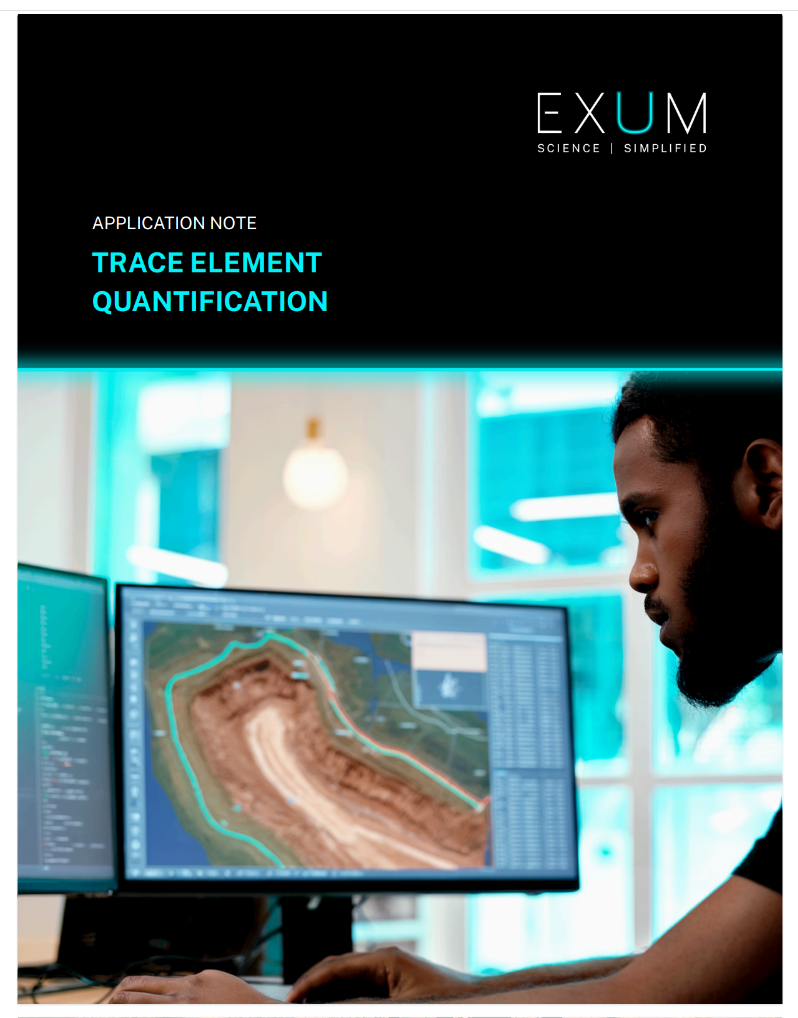
Trace Element Quantification from Li to U
Analyzing USGS black glass reference materials, the study demonstrates quantification of major, minor, and trace elements in a single analytical session.
Results encompass elements from lithium to uranium, including rare earth elements, achieving detection limits in the high parts-per-billion range.
This application note showcases how direct solid sample analysis eliminates complex sample preparation procedures, reduces total analysis time, and enables reliable detection of difficult low-mass elements alongside high-mass elements in the same analytical session.
Download Now:
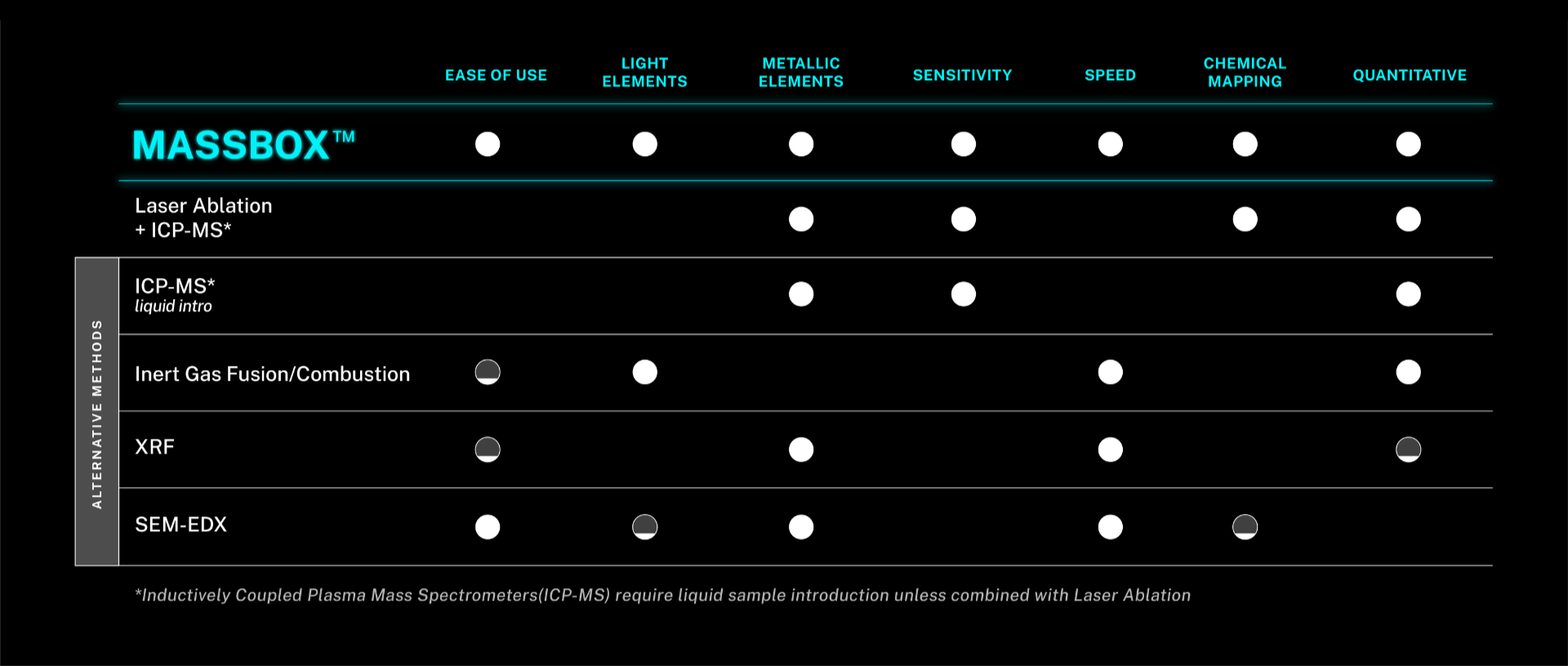
How Does Massbox Compare?
Subscribe: Get materials science breakthroughs direct to your inbox
.png?width=1000&height=563&name=Untitled%20design%20(8).png "Untitled design (8)")